( No Title )
Restoring the Sense of Touch in Amputees Using Natural Signals of the Nervous System
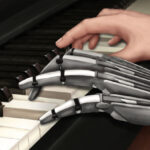
Scientists at the University of Chicago and Case Western Reserve University have found a way to produce realistic sensations of touch in two human amputees by directly stimulating the nervous system.
The study, published Oct. 26 in Science Translational Medicine (STM), confirms earlier research on how the nervous system encodes the intensity, or magnitude, of sensations. It is the second of two groundbreaking publications this month by University of Chicago neuroscientist Sliman Bensmaia, PhD, using neuroprosthetic devices to recreate the sense of touch for amputee or quadriplegic patients with a “biomimetic” approach that approximates the natural, intact nervous system.
“If you want to create a dexterous hand for use in an amputee or a quadriplegic patient, you need to not only be able to move it, but have sensory feedback from it,” said Bensmaia, who is an associate professor of organismal biology and anatomy at the University of Chicago. “To do this, we first need to look at how the intact hand and the intact nervous system encodes this information, and then, to the extent that we can, try to mimic that in a neuroprosthesis.”
Funding: The study, “The Neural Basis of Perceived Intensity in Natural and Artificial Touch,” was supported by the Defense Advanced Research Projects Agency (DARPA), the Department of Veterans Affairs, the National Science Foundation and the National Institutes of Health. Additional authors include Matthew Schiefer from the Louis-Stoke Veterans Affairs Medical Center, and Hannes Saal and Benoit Delhaye from the University of Chicago.
Raise your voice in support of expanding federal funding for life-saving medical research by joining the AAMC’s advocacy community.
Discussion ¬